

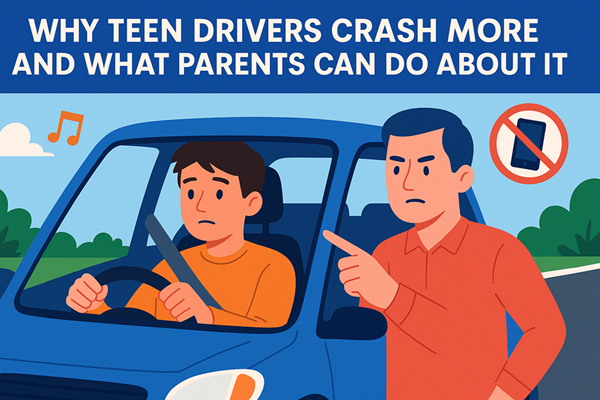
03 Nov Why Teen Drivers Crash More and What Parents Can do About it
For teens, driving feels like freedom, but it also comes with a very real level of risk. We’ll run through the UK’s young driver statistics, look at why young drivers are more vulnerable, and tackle the hard question of “how many young drivers die each year”. Then we’ll move on to the steps you can take as a parent to cut that risk down.
The hard numbers: Young driver statistics UK
- Research shows that around 1 in 5 newly-qualified drivers crash within a year of passing their test.
- 1500+ young drivers are killed or seriously injured on UK roads every year.
- According to the latest from the Department for Transport (DfT) factsheet, in 2023 there were 487 drivers of all ages killed in car collisions, of whom 90 were “younger car drivers” (aged 17-24). That means younger drivers made up 18% of all car driver fatalities.
These stats are sobering, every driver on the road under 25 has a higher risk of being killed or seriously injured. Male drivers aged 17-24 are about four times more likely to be killed or seriously hurt than someone aged 25 or over.
Why young drivers are dangerous
There are a couple of reasons for this, and they’re worth unpacking.
- Inexperience and immature hazard-perception
New drivers simply haven’t seen enough of the road to spot tricky hazards, judge speed or react reliably. The part of your brain that is responsible for impulse control doesn’t fully mature until mid-20s, while the region that seeks thrill and can be very influenced by peers is very active in teens, leading to some very bad outcomes. - Over-confidence and risk-taking
A lot of young drivers think they’re sharper behind the wheel than they actually are, and that’s when you start seeing the speeding, dodgy overtakes, tail-gating and heavy braking.
Having a group of mates in the car ramps up the danger. A newly-qualified driver with a car full of people their own age is four times more likely to end up in a fatal crash than if they were on their own.
- Distracted/ impaired driving
Younger drivers are more likely to use mobile phones at the wheel or to drive at night with less supervision.
So how many young drivers die each year?
Although there is no current data for 2024, back in 2023 approximately 90 young car drivers were killed in Britain and that’s before you even add the serious injuries, another 1,327 young drivers.
What can parents can do?
You’ve got influence. A lot of the risk reduction lies not just with the young driver, but with parents or guardians who set the tone.
Set clear expectations
- Sit down and talk about what safe driving means in your household:
- No phone use while driving
- No friends in the car until they’re ready
- curfew on night-drives
- Share the stats with them. When a teenager realises the numbers (1 in 5 crash, young drivers make up 18 % of deaths) it may hit home and feel more real to them.
Use a driving contract
Draft a simple agreement:
“We agree that you will drive only with X number of passengers, only between certain hours, you’ll keep your speed within limit, you’ll check in when you arrive.”
Monitor and mentor after the licence
- Don’t just hand over the keys:
- Take time riding as a passenger
- Point out hazards
- Discuss near-misses
- Encourage insurance with a “black box” that monitors driving behaviour. This can reduce risky behaviour by enabling parental monitoring.
- Restrict “high-risk” conditions early on, for examples:
- Avoid late-night drives
- Carry fewer passengers until experience is built.
Choose the right first car and insurance
- Make sure the vehicle has good safety features, such as:
- ABS
- Stability control
- A strong crash rating
- Discuss insurance implications. Premiums for younger drivers are higher because the risk is that much higher.
- Make sure you discuss the cost of mistakes. A crash can cost you both your life and a much emptier pocket.
Lead by example
- If the parent(s) demonstrate safe driving habits (no phone use, modest speed, always wearing a seat belt) it sets the standard.
Once you have been out for a drive why not also do a “driving reflex review” together? You can ask your young driver what hazards they noticed whilst on the journey and what they might do differently next time.
Encourage ongoing learning
- Even after passing the test, encourage your son/daughter to take advanced training or refresher sessions.
- Make sure they recognise that passing the test is not where they stop learning, it’s just the beginning.
How we can help
If you’re looking for a driving school that delivers flexibility, quality, and real-world results, Adams Driver Trainer is a strong choice. Our instructors are fully DVSA-qualified, and many have years of experience teaching both manual and automatic drivers. We offer one-to-one lessons (so you get focused, distraction-free instruction), door-to-door pick-ups, and flexible scheduling, including evenings, weekends and even bank holidays, making it easier to fit lessons around your work, college or personal life. On top of that, with options like block bookings and mock-tests with different instructors, we make it convenient to build up confidence and skills quickly.
Lastly, our track record, many learners passing their test first time with minimal faults, speaks to our ability to help you become a safe, capable driver who’s well-prepared for both the test and everyday driving.

Sorry, the comment form is closed at this time.