


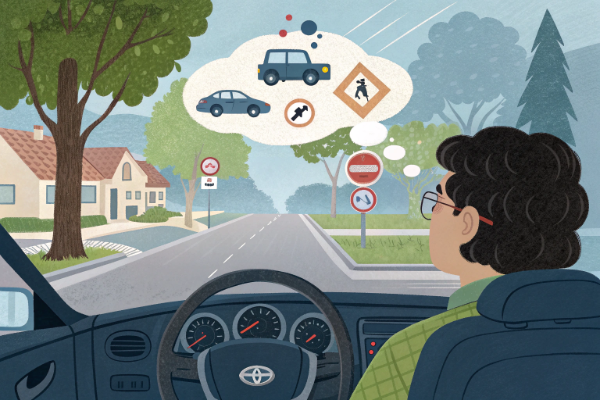
Every learner driver knows the mechanics: clutch, gears, mirrors, roundabouts, hazard perception, all the nuts and bolts needed to pass your test. But what if the #1 thing holding back your progress isn’t mechanical skill at all? What if it’s the way you’re thinking while you’re driving?
This isn’t about knowing the Highway Code inside out, it’s about training your driving mindset: how you anticipate hazards, make decisions under stress, and build confidence one thought at a time.
The invisible side of driving: Your brain behind the wheel
Driving isn’t just a physical skill, it’s a cognitive and emotional process. Your brain is constantly:
- Scanning for hazards,
- Predicting other road users’ behaviour,
- Making split‑second decisions,
- and self‑talking (“I can do this”… or “What if I mess up?”).
Psychologists studying driver education increasingly highlight that confidence, mindset and thought patterns play a huge role in learning progress, sometimes even more than the muscle memory of gear changes and steering.
This means learning to think like a driver can accelerate your progress dramatically, even before you’re perfect at manoeuvres.
1. The “Growth mindset” advantage
Instead of thinking “I made a mistake, I’m bad at driving,” try reframing your thoughts:
- “This is progress, not perfection.”
- “Every mistake teaches me how not to repeat it.”
- “I’m learning to anticipate, not just react.”
This mindset shift isn’t fluff, research shows that drivers who build positive internal narratives about learning are calmer, more focused and make fewer critical errors behind the wheel.
2. Anticipation – The mind’s early warning system
Experienced drivers don’t just react, they predict.
Instead of waiting for the hazard, they ask themselves: What could happen here?
Try these thought habits on your next lesson:
- “What’s the most likely thing that could go wrong here?”
- “If the car ahead suddenly brakes, where’s my safe space?”
- “Where are the pedestrians likely to appear?”
Training your brain to anticipate builds decision‑making speed, a key test skill that never appears in theory cards but shows up every time you’re driving.
3. Self‑talk: Your in‑car coach
What you say to yourself while driving matters. There are two types of self‑talk:
✔Empowering self‑talk – “I’ve practiced this, I can handle it.”
✖Sabotaging self‑talk – “I’ll never get this right.”
Try replacing anxious thoughts with supportive ones. Even experienced drivers use quiet, positive cues to stay calm under pressure.
4. Visualisation: Driving in your mind first
Before you start the engine, spend 30 seconds imagining:
- Pulling out safely,
- Approaching a junction with confidence,
- Executing a smooth parallel park.
Athletes do it; performers do it. Drivers can too, and it works. The brain wires neural pathways during visualization just as it does during real practice, reinforcing skills faster and with less stress.
5. The hidden benefit: Confidence that lasts beyond the test
Once you master the mental side, improvements become noticeable:
- Fewer nerves before lessons
- Faster recognition of hazards
- Better focus in traffic
- Less self‑criticism
- Smoother decision‑making
And isn’t that what every learner wants, not just a licence, but confidence on the road?
Your next mini challenge
Before your next lesson:
- Spend 2 minutes thinking positively about what you’ll achieve.
- Ask yourself: “What am I ready to learn today?”
- Reframe one negative thought into a growth one.
You might be surprised at how quickly it improves not only your driving skills, but also your attitude and confidence behind the wheel.